Posts

Showing posts with the label visual schedules

Post #40 Summertime tips: Keep it simple!
Image
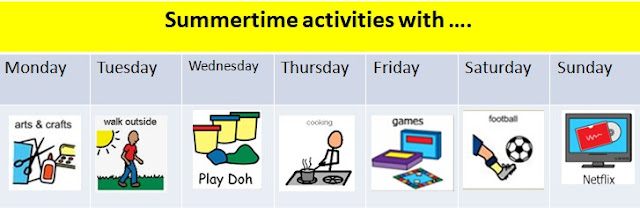
Prolonged lock-down and closure of schools may mean that this year's summer break feels overwhelming. Structuring the day and planning activities may feel more challenging than usual. My next series of posts offer some summer tips which will hopefully help to make the summer more manageable and enjoyable.  The summer break can feel overwhelming at the best of times, but when the summer follows on from months of home-learning it is not surprising if you feel anxious, stressed and not knowing where to start. This first tip focuses on how to structure summertime days, with an emphasis on keeping it simple. The secret is to try to find the right balance between providing the structure your son or daughter needs and at the same time making this manageable so that you can have some time to get on with chores, or dare I say to take a break! You son or daughter may already use a schedule at home, or have been using one during home-learning. It may well be that they need the same lev...

Post #7 Transition objects & finished

Image
Autism and learning difficulties and young children. For many children and young people, following a 'first - then' sequence of activities may not be the best way to provide information about their activities. In particular, children in the early years and children and young people who have autism and learning difficulties may not find this 2 step sequence meaningful. In this case you may be more successful by providing information one step at a time.  Transition objects are objects of giving meaningful information to your child. For example, a toilet roll indicates " toilet", a cup means "snack". Transition objects should be chosen depending on your child's understanding and based upon what is meaningful to them. If this is new to you, or is a strategy you have not used at home before, start by selecting objects for key routines of the day (e.g., toilet, snack, lunch, play, garden and so on). Start by selecting 2 of the objects which you think you...

Post #5 Supporting your child to make choices - & freeing up some of your time to get on with chores or to take a break!

Image
An important addition to your home-learning structure is adding choices or free time. If your child is able to choose an activity and spend some time occupying themselves with that chosen activity, this may give you time to get on with a chore or, dare I say, put your feet up with a coffee! Choose time can be incorporated on your child's schedule . You may need to use different visual information from that used on your child's schedule to ensure they do not confuse scheduled activities with choose. For example, a child who has a written schedule might have symbols or pictures on a choice board, this gives clarity between activities you have to complete and activities you can choose. 'Choose' can be depicted in different ways, depending upon your child's visual understanding. This example shows how you might use images cut out of toy packaging to clearly show what choices are available for a young child: In this example, 'choose' is a hand-drawn...

Post #4 Visual schedules continued - brain breaks

Image
clipart-library.com Ben said: "I like my schedule because it is like a rhythm flowing." What a lovely way to explain why he likes his schedule :)   I am aware that for some of you visual schedules are helping your child with the order of the home learning day. An important element on the daily schedule should include time for ' brain breaks '. We know that many children and young people with autism have what I call 'busy brains'. This may be due to the way their brains process information, this may be because their brain does not always filter out the information which is not relevant or not important. They may be processing small details which would usually be filed in the brain as 'ignore' or 'not relevant'. As a result their brain is very busy all the time and can become overloaded, like a computer that crashes if overloaded. Imagine all the information is arriving in their brain through a magnifying glass. Brain breaks can be bui...

Post #3 Visual schedules (STRUCTURE 2)

Image
Many of your children use a daily schedule at school. Schedules build on First Then by sequencing longer chunks of time - part day or whole day. Individuals who are on the spectrum have difficulties with organising and sequencing activities. At the same time, they need predictability and routines. Visual schedules are a way of showing what and when , which helps children with autism to understand the structure of their day. This reduces anxiety and increases independence, which is important for self-esteem. Given the current situation and 'stay at home' ruling, it will be helpful for you and your child if you can find ways to structure their day. If you want to set up a home learning schedule, here are some tips : Use visuals to provide information on the schedule which is meaningful for your child. Visual information can be very powerful for our children as many of them have strengths in visual processing. Depending on your child's understanding, the schedule ...