Posts

Post #40 Summertime tips: Keep it simple!
Image
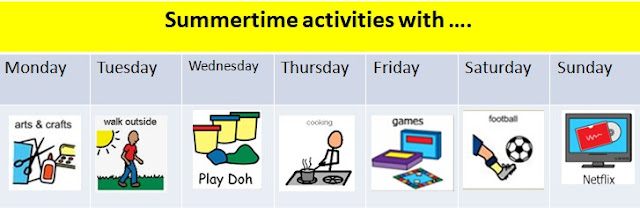
Prolonged lock-down and closure of schools may mean that this year's summer break feels overwhelming. Structuring the day and planning activities may feel more challenging than usual. My next series of posts offer some summer tips which will hopefully help to make the summer more manageable and enjoyable.  The summer break can feel overwhelming at the best of times, but when the summer follows on from months of home-learning it is not surprising if you feel anxious, stressed and not knowing where to start. This first tip focuses on how to structure summertime days, with an emphasis on keeping it simple. The secret is to try to find the right balance between providing the structure your son or daughter needs and at the same time making this manageable so that you can have some time to get on with chores, or dare I say to take a break! You son or daughter may already use a schedule at home, or have been using one during home-learning. It may well be that they need the same lev...

Post #39 Preparing for a COVID-19 test

Image
If your son or daughter needs to have a COVID-19 test, preparation is essential.  Explain my procedure COVID swab testing video with clear visuals and subtitles This is an important time to use a visual schedule, providing clear information about the sequence of activities and indicating what will follow when the test is finished. In this example the young person can see that they can take their stress balls to squeeze during the test. Boardmaker symbols TEACCH Tip #17   provides some good suggestions for how you might explain the process, find it here: Preparing for COVID test and includes how to use: visual step by step instructions social narrative or social story distraction toys or activity visual countdown for the test This TEACCH tip includes Downloadable stories for testing at home, at the doctor's and at a drive-through. These can be adapted according to the situation and your son's or daughter's needs. Finally, make sure there is a cl...

Post #38 Time for Change

Image
I began this blog at the start of a lengthy period of lockdown in our homes. Schools closed and many children and young people experienced significant change regarding their education. Recognising the scale of the challenge for families of autistic children and young people, I embarked on this blog as a way of sharing my knowledge and experience to suggest home-learning strategies and resources. Whilst lockdown eases, the 'big school holiday' looms and yet more change is likely for the foreseeable future. As we gradually move towards children and young people returning to school or college, so begins the 'new normal'. There are many uncertainties that will cause anxiety, but one thing is certain: change is the new normal . As a result, many autistic children and young people will have to cope with further changes which they may find challenging, not least the concept of 'bubbles' and new ways of working at school.    The need to prepare for, and cope wit...

Post #37 Behaviour (5) To do or not to do…. Strategies for Everyday

Image
Behaviours which feel challenging can be frustrating and upsetting. Pause and give yourself a break. It is important to have some everyday strategies to maintain wellbeing which in turn may reduce difficult behaviour.This post offers some tips for everyday strategies, some suggestions for what you might do and what it is better not to do, which may help to prevent behaviours from escalating.  Structure  Always consider structure and routines as part of your everyday strategies. We all need structure and routine in our daily lives. For autistic children and young people, structure and routines are essential to provide information in a meaningful way and to reduce anxiety. The use of structure is empowering. Structured Teaching (TEACCH) strategies increase independence, raise self-esteem and as a result can reduce difficult behaviours. For example, a visual schedule provides vital information about the structure of the day: what, when, where, who. This is not that far remov...

Post #36 Behaviour (4) Ask the right questions, work out the message(s) and plan what to try.

Image
Managing behaviour that feels challenging is not easy, particularly when a specific behaviour occurs frequently, has been going on for a long period of time and is intense. It is important to be aware at these times that a child or young person may be distressed and frustrated and so are you. This post focuses on ways to plan strategies for your son or daughter, based on your observations and using a problem-solving approach. When you are in the middle of a ‘storm’, both your child and you are not feeling good. This is not the time to sit down and try to problem-solve. Do what you need to do to keep everyone safe and to restore some semblance of calm. Don’t feel bad if that means leaving your son or daughter to watch favourite apps, YouTube films, play computer games etc. Take a few minutes for yourself too. Strategies to manage behaviours which have become challenging need some time to think, to figure out the message (intended or not) and to plan ways to support your son or daugh...

Post #35 Behaviour (3): Behaviour and Communication

Image
An essential part of the behaviour iceberg is communication. Most behaviours have meaning, but we need to make sure we proactively look for that meaning. A shift in mindset from focusing upon a behaviour to thinking about communication helps to have a more positive focus and attitude towards behaviour.  The iceberg model helps us to think about the underlying reasons for behaviour and to try to understand how the individual might be feeling. Behaviours are often an expression of how someone is feeling and it can be useful therefore to think about behaviour as communication. Communication involves intentionally sending messages to another person, with the expectation that they will respond in some way.  Whilst not all behaviours are intentional communication, it is helpful for us to think about communication as integral to behaviour as this helps to develop supportive strategies. Professor Rita Jordan, renowned for her knowledge of autism, explains:  “The ...

Post #34 Behaviour (2) Looking Below the Waterline - Feelings

Image
With prolonged school closures and uncertainty about almost everything, it is not surprising if you are seeing more behaviours at the tip of the iceberg than is usual for your son or daughter. This post is about looking below the waterline to think about feelings and how these relate to how an individual behaves. H ow are you feeling about the current situation, the many uncertainties and the sometimes unfathomable decisions regarding the way forward? How have your feelings affected the ways in which you behave? Perhaps you have been more irritable, or maybe you have withdrawn from usual activities? The same may well be true for many autistic children and young people. They may be experiencing feelings which are more intense than usual and/or feelings they have not experienced before. They may well be behaving in ways which are different from their usual behaviours and you may feel overwhelmed by behaviours at home which are more intense and/or which you are finding difficult to ...